

A bit about publishing books and personal branding
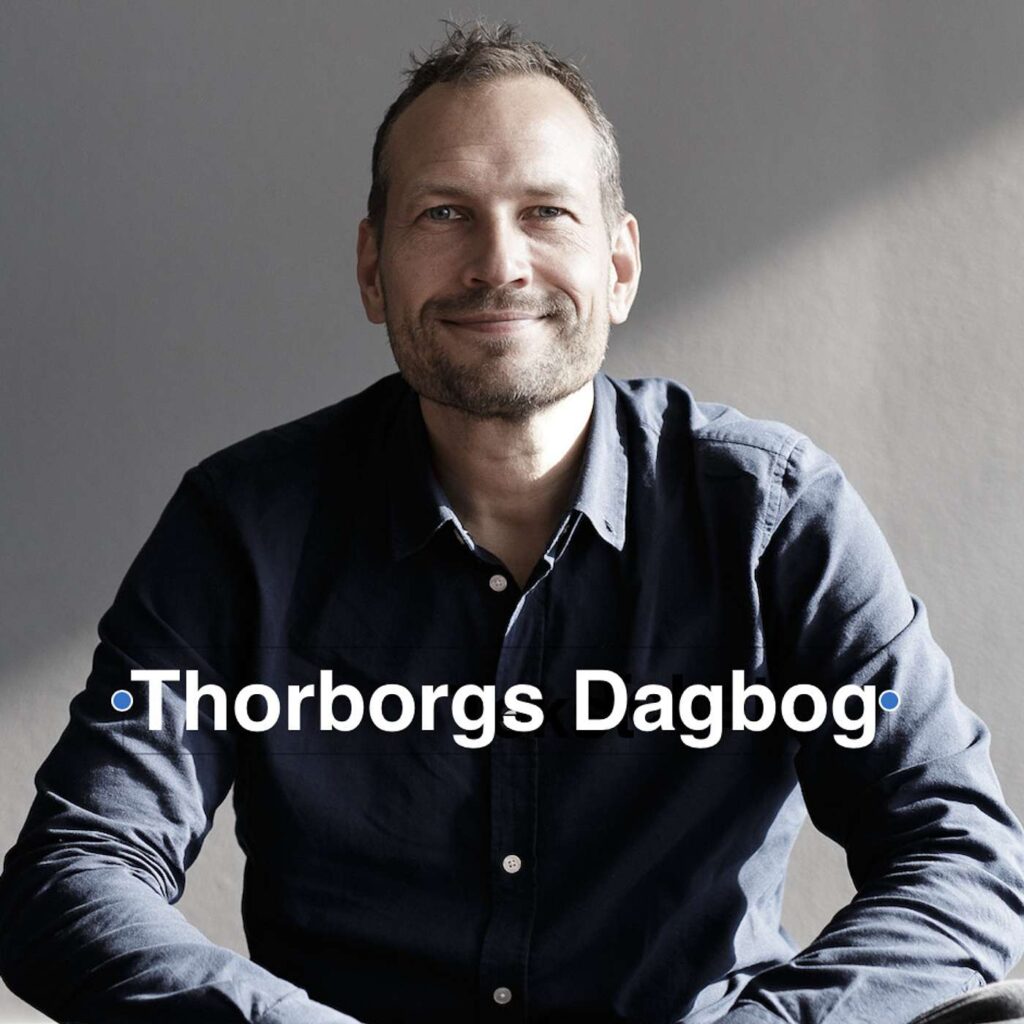
Today I want to talk about book publishing and personal branding. My new book, Skab din egen succes, comes out tomorrow. I’m sitting in the bedroom with my laptop, still a bit wound up after giving a talk. I want to share my experiences with books and the personal name that can help get them out to readers.
Thorborgs Dagbog · Episode 6 · Recorded 28 March 2023
A part-time job is also a way into adult life
I’ve been out near the airport giving a pep talk about leadership to around 330 shopkeepers and managers from 7-Eleven. They meet for a big event once a year.
Not everyone may think about the fact that behind each shop is a shopkeeper responsible for staff, motivation and finances. It’s much more than just a convenience store where you can buy something.
Both my son and my daughter work at 7-Eleven, and my stepson Holger would like to as well. He’s just done some work experience. Frank and Sandra, who run the shop in Lyngby Storcenter, have been really kind to my children. They had just celebrated their twentieth wedding anniversary, so I got them to stand up and everyone applauded.
I thanked them and also reminded the shopkeepers that parents send their teenagers to work for them. You send in a fourteen- or fifteen-year-old child and get a more grown-up person back a few years later. Learning to take responsibility and arrive on time matters.
They were in good spirits, even though my talk was late in the day. I think they’re in for a good party tonight.
A small, exclusive podcast audience
I’ve also been looking at the podcast statistics. It’s quite interesting to compare them with social media. A reel I made about a month ago has been viewed 320,000 times on Instagram. That platform is really moving.
A new podcast starts more quietly. The first episode of this diary has the most plays, at 959, and altogether we’re at around 3,412. I’m actually happy with that.
We have a small, exclusive group who are willing to listen to me sit here letting my thoughts out. Thank you for being here. I’m really glad about that.
Around thirty percent of plays come through Spotify. For me, Spotify has mostly meant music, but quite a few people also listen to podcasts there.
Advice to my eighteen-year-old self became a book
Tomorrow, 29 March 2023, sees the publication of Skab din egen succes. It will be available at Bog & idé and Saxo, among others.
The project actually began about ten years ago when I wrote advice to myself as an eighteen-year-old. I think it started with about fifteen pieces of advice. They were widely shared and gradually grew to twenty-five or thirty.
Then Gyldendal asked whether it might be fun to make a book for young people being confirmed, those finishing upper secondary school and those who don’t. I thought it would.
The advice had also struck a chord with many of us who use Facebook. I hope young people will want to read the book, or their parents will buy it for them.
This isn’t the book that’s going to make me a millionaire. I estimate that I earn around twenty to thirty kroner per copy. Even five thousand books sold won’t put the next Porsche in the garage. But that isn’t the point either.
I hope the stories will be useful. I also talk about them on Instagram Reels and TikTok. If you don’t have the money for the book, or would rather hear me tell the stories, there’s free content there.
Anders and I made the first book ourselves
It started with my good friend and then speaking agent Anders Gisselmann. He asked whether we should make a book about entrepreneurship. Anders is a bloody good writer.
He came along to some of my talks and wrote from those. I wrote too, and then we wrote it together. It became Iværksætter til jeg dør.
We published it ourselves and split the profit. There was no publisher involved, and it actually became a good little business.
I can’t remember the figures exactly, but in the recording I estimate that by then we’d sold around fifteen thousand copies and earned an average of about 180 kroner per book excluding VAT.
E-pusher: Customers buy the value, not the file format
The next book, E-pusher, became an even better business. It was primarily a PDF with advice for online retailers. E-commerce was still new, and there wasn’t much material in Danish about what to do.
I recorded the book on a dictaphone while walking with the pram on Gran Canaria. My son had colic, so he had to be kept moving. I had the recording transcribed and worked on the text until it held together properly.
When I asked what I should charge for it, people said around a hundred kroner. After all, it was just a PDF, not a real book.
At about the same time, I bought a report about writing better newsletters. It cost three hundred dollars, which at the time was around fifteen hundred kroner.
Why was I willing to pay that much? Because if just one of my newsletters got a little better, I could earn that money back many times over.
So I priced E-pusher at fifteen hundred kroner plus VAT, or 1,875 kroner including VAT. In the podcast, I estimate that I sold around three and a half to four thousand PDFs and ended up with a profit of about four million kroner.
That wasn’t bad at all. I also think it inspired others to charge properly for things like SEO books. They owe me a cold beer for paving the way.
So why publish through a publisher?
Min vej som leder I published with Gyldendal. Why do I do that when I can earn more per book by publishing it myself?
It isn’t primarily because I expect a publisher to magically sell a lot more books. I think Anders and I did pretty well selling them ourselves too.
It’s about all the work around the book. I get an editor and someone to discuss things with. There are people for PR and marketing. They find the printer and take care of the barcode, pictures, cover, back-cover copy and a good title.
It’s a sort of all-inclusive arrangement where I don’t have to think about everything.
Financially, it might not be the best solution, but for me it’s a good idea if I want to avoid burning out. I have investments in startups, a full-time job at Dinero, books, three lovely kids, a beautiful wife and all sorts of other projects.
So it makes sense to pay other people to take care of some of the work.
Book publishing and personal branding: The book has to sell too
You can certainly publish it yourself. Getting a good-looking book printed isn’t necessarily difficult or expensive. I’ve previously used LaserTryk and paid around twenty-five kroner per copy for a book of about 250 pages, with a print run of a few thousand. Those are the figures from my experience at the time.
The challenge comes when you’re standing there with the books. How do you get anyone to buy them?
You can shout in your residential street or post on your Facebook profile with twenty family members and twelve friends. But there’s a limit to how far that will get you.
You need a way to reach readers. An audience, some social profiles or something else that already has a bit of momentum. And that brings us to personal branding.
What do you want to be known for?
Lasse Nørgaard has asked how you build a personal brand like mine. I’m a bit too tired to go into it in depth tonight, but here are a few points.
Start by asking yourself what you can do. Are you good at dancing? Do you know something about programming? What interests you, and what are you really willing to learn about?
Then communicate it in a way that suits the subject and the audience. If it’s very visual, Instagram might be an obvious choice. If it’s more text-based, a blog or Facebook might work. You can also combine channels.
Those are my thoughts here in 2023. The main thing is to choose somewhere you can share something that other people actually find useful.
Make it easy to contact you
When you’re working with your name and your knowledge, make it possible for journalists and other interested people to find you. A phone number or email address can make a difference.
You can also approach relevant trade magazines and newspapers with columns. If your subject is IT, Computerworld could be a place to start. Write something that suits their readers.
Right now, in March 2023, there’s a lot of interest in ChatGPT. I imagine a good column about it could also interest business media, because many people are trying to understand what the technology means for their business.
At Dinero, we already have three AI people working with the technology inside the program, and we’re also getting a presentation about the language-based part. I find it exciting to imagine being able to write one day: How does my revenue in March this year compare with last year? And then get some graphs back.
That’s an idea of what the technology could do, rather than a description of a finished feature at that time.
Start narrow so you can get noticed
Choose something you know about or want to learn a lot about. It can also tie in with other people’s interests or a trend.
If the subject is very narrow, it may be a good idea to think internationally. If it’s very broad, it becomes hard to stand out.
Take football. A hell of a lot of people write about football and know a lot about it. If you start with one player and really go into depth, you’re more likely to get noticed than if you simply call yourself a football expert.
The same goes for watches. If you love Rolex, there are already plenty of experts. Perhaps you should start with one particular model. Find the stories, pictures, details and everything interesting about that specific watch.
A narrow focus can open the door to something bigger
I use an analogy from my time in the military: A concentrated jet can penetrate armour in a way that something dispersed cannot. That’s the image I have in mind when I talk about focus.
You don’t have to start by selling every imaginable product. You can become really good at one thing and expand from there.
I met some nice people in Copenhagen who had built a business selling razor blades and later expanded into things like coffee capsules. They sent cocktails over to me because something I’d said or written had apparently helped them.
My point is the same when it comes to your personal name. If you become a real authority on the Rolex Submariner, you might attract followers who love that watch. Then you can gradually add another model and later a broader area.
If you just start with watches in general, you risk being rather irrelevant, however hard you work.
A new field can allow a broader start
Among other things, I give talks about leadership, which isn’t exactly a narrow subject. But I can do that because I’ve already built my name.
When I started, I spoke about e-commerce. That sounds broad today, but back then it was new. It’s easier to be broad when the field itself is still being created.
I mention padel as an example in the recording. Perhaps at that time you could still become the Danish expert the media would call if you really got into the game, the players, the rules and the techniques.
Once you’ve gained a foothold, you can expand. Perhaps into a related sport, perhaps by communicating the same things in English or to audiences in Sweden and Norway.
Start with a very clearly defined subject and build on it once you have a foundation.
A busy day tomorrow
That jumped around a bit, but this is my diary. I talk about what’s on my mind, and sometimes about the things you ask about.
Tomorrow will be hectic. I’m appearing on both Go’ aften Danmark and Aftenshowet and will have to rush from one to the other. On Aftenshowet, I’ll be appearing with Claus Meyer.
It’ll probably be nice too. Take care.
Listen to the episode
Watch the episode on video
Listen in your podcast app:
All episodes on Apple Podcasts · All episodes on Spotify · All episodes on Amazon Music · RSS Feed