

Being a micro-medium has something to offer too
I’m on my way home from a VL meeting at Børsen, where we’ve been discussing media. There was a lot of talk about the big players. But I think we’re overlooking something interesting: someone with something to say can build a micro-media outlet and a business around it.
Thorborg’s Diary · Episode 73 · 25 September 2024
Watch the episode on video
Listen in your podcast app:
All episodes on Apple Podcasts · All episodes on Spotify · All episodes on Amazon Music · RSS Feed
A family trip at full throttle
I’m a little hoarse. I’ve caught a cold, and I’ve been using my voice a lot. It’s been a few wild weeks.
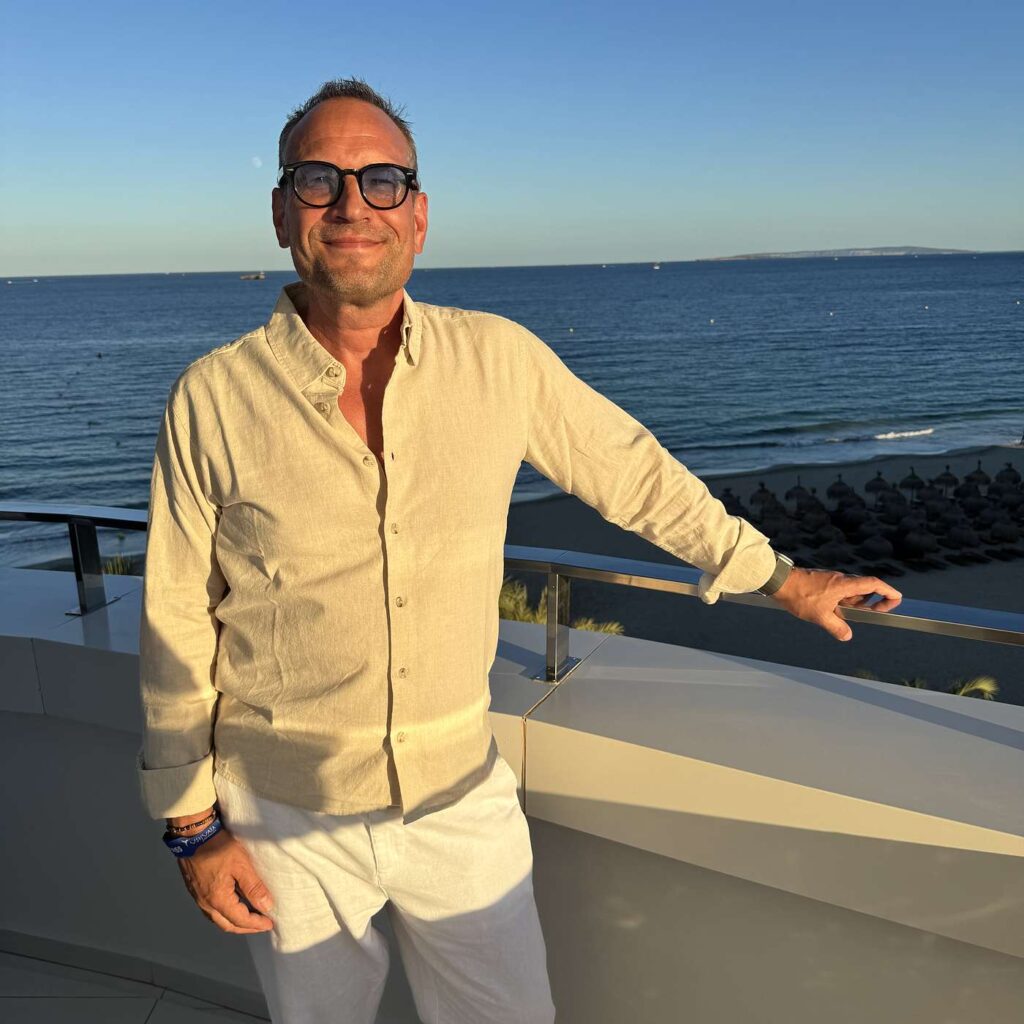
We’ve been on the annual family trip to Ibiza: my wife Jannie, her brother Jesper Buch, her sister Anne-Sophie and her partner Søren, and a group of other lovely people. Ten in total.
Three or four days there is bloody good fun, but also hard going. We stayed at Ushuaïa. It’s fascinating to see the party start at 3 pm and run until 11 pm. Afterwards, they tear everything down and build new stages so it can all reappear the next afternoon. That goes on all summer.
The first evening was a little disappointing. The music was too quiet for my taste. But when Dutchman Armin van Buuren went flat out, it was bloody fun. We finished with David Guetta. If you like his music, it’s a bloody great time.
After 11 pm, we carried on at Hï. One evening we went home to sleep; another, we had a party in the room. We’re running a proper teenage circus. But we laugh, listen to great music and have an amazing time together. Then you’re wiped out for the next three or four days.
To Greenland on their terms
On Friday, I’m going to Greenland with Jesper. We’re giving talks to business leaders, and the boys are coming: Jesper’s son Oscar and my boys Mads and Holger.
There are plans for fishing, shotguns, ATVs and lots of experiences. Jesper and I will also offer some inspiration to the local leaders.
I’ve heard stories about young Greenlanders being fed up with Danes. That worries me a little before the trip. I hope we’ll be welcomed.
We aren’t coming to bother or lecture anyone. We want to inspire, just as we’ve tried to inspire business leaders in Denmark. And we’re coming to visit their country on their terms, with great humility. I’ll tell you more once we’ve been.
I’ve got some of my old drive back
If you follow the podcast, you’ll know I’ve talked about supplements and testosterone. There are several earlier episodes about that journey.
I feel my mood has improved and I have more energy. My measurements say around three kilos more muscle mass, and I’m exercising a little more too. I feel stronger and younger.
That motherfucker, that drive I gradually lost over the past five years, feels like it’s back. It’s been a wild and rewarding journey for me. And it isn’t over. I also have a startup on the way with some talented people in this area. More on that later.
I find biohacking exciting. To me, it makes sense to take an interest in how the body works and what you can do to feel better. I compare it a little to a car you never maintain: it gets more worn, dirtier and shabbier, and things start breaking.
We all get older, and we’re probably all going to die too. Perhaps a miracle treatment will come one day, but I doubt it’ll happen in time for me. I just want to feel good in the time I have.
I’ve encountered the view that you should accept your age and the abilities and wrinkles that come with it. But then don’t you wear glasses either? Or use crutches if you fall? Should you just drag yourself along the tarmac?
My view is that people should do the things that make them happy. If you’re unhappy about your hair, you’re welcome to do something about it. If you’re unhappy about your breasts, you’re also welcome to choose cosmetic surgery. I struggle more with all the Instagram filters where you pretend to be someone else. But doing something for your own wellbeing makes sense to me.
Editorial note: These are Martin’s personal experiences and opinions. They do not demonstrate a general effect of hormones or supplements. Testosterone treatment requires medical assessment and follow-up; read more at Sundhed.dk.
The big media outlets are struggling
Back to the meeting at Børsen. When we discuss media, we often think of Berlingske, Børsen, DR, Politiken and Jyllands-Posten. Consolidation is happening, and some outlets disappear.
Local media in particular can struggle to find a viable business model. In my view, Bornholms Tidende has done well and turned around a difficult situation. But not all local media succeed at that.
My rather blunt view is that the effect of old-fashioned ads has often been exaggerated. When you can spend a thousand kroner on a digital ad and track the results, it can feel more attractive than spending 20,000 kroner on an ad whose impact you’re unsure about afterwards.
Facebook and Google take a large share of the advertising market. I’m also critical of their use of other people’s content. That doesn’t make the situation easier for media outlets.
We discussed how the tech giants will probably get bigger, established media will need to consolidate and smaller outlets will have a harder time. But in my opinion, part of the picture was overlooked.
I prefer the word micro-media
A person with an interesting message, knowledge, charisma, passion and the ability to communicate can actually build a pretty good business.
You can call them an influencer. I just struggle a little with that word. It makes me think of Fie Laursen and Gucci bags, yellow Lamborghinis and Dubai. That’s not quite what I associate with my own work.
That’s not a bad word about her. She’s reinvented herself many times, and that’s a skill too. Perhaps I’m not very up to date on what she does either. I just prefer the word micro-media.
It can be a serious outlet about management or any other area where you have something to offer. It doesn’t need to be about polished pictures and expensive bags.
My setup costs around 200 kroner a month
Look at the technical side of my podcast. I use an iPhone. In principle, you could also use a 500-kroner voice recorder.
Right now, I’m recording through the car’s microphone into the phone. I don’t actually know where the microphone is. I’m driving on Helsingørmotorvejen at about 83 kilometres an hour, following some other cars.
Afterwards, I run the audio file through Adobe Podcast. It’s an AI filter that removes much of the car noise. Adobe isn’t paying me to say that. I mention it because otherwise I get lots of questions about what I use.
I don’t use jingles and all that other stuff. I can’t be bothered. The file gets processed and uploaded to my podcast service. I can’t remember the name while I’m talking, but the podcast is on Buzzsprout.
At this point, the AI tool costs me about 70 kroner a month, and the podcast service around 120, as I remember it. Roughly 200 kroner for my own media outlet.
The podcast is approaching 250,000 downloads. On top of that, there are YouTube views, which I haven’t added up precisely. My own rough estimate is five, six or seven thousand fairly regular listeners. It’s a nice little media outlet.
In the old days, you needed a studio, a radio station or to press a CD and get it distributed. The financial and technical barriers were much higher. Today, the challenge is more about originality, personal branding and having something to say.
I made around 100 videos before I found my voice
You can go back on my YouTube channel and watch my first video. It’s a load of crap.
I think I made around 100 videos before I found a way of doing it that I liked myself. A way that reflected my brand and attracted people who liked the same thing.
From there, I’ve built my own little media conglomerate. I’ve self-published books and also tried publishing with Gyldendal. Distribution has been a decent success. Financially, it’s been worse than my own publications.
As I remember it, I’ve earned around one and a half million from Iværksætter til jeg dør and three and a half to four million from E-pusher. My management book and the book for my younger self at Gyldendal have perhaps earned me 200,000–250,000 kroner combined. That last figure may even be on the high side.
I don’t track the sales figures precisely, but both books have been relative bestsellers, with around 10,000 copies sold each, as I remember it. The point is that distribution and what you personally keep are two different things.
Each platform is a craft of its own
A personal brand is largely about patience and authenticity. Giving something of yourself. I don’t think you get far by only making polished pictures.
I use LinkedIn one way, Facebook another, Instagram a third and X a fourth. I’ve studied the audiences and what they like.
Is it pictures? Text? Combinations? Long videos or short ones? It’s a craft you learn gradually. You can watch videos about it, read books and experiment.
When I started on YouTube, I got loads of criticism. Journalists wrote about my microphone, looking into the phone, the distance from the camera and how I should use more cameras. I spoke too superficially, for too long or too briefly.
I took some of the criticism on board. There was some truth in it. But some of it was also about rules from the old media.
"You need to make it half an hour or an hour." Why? Because it needs to fit a format on scheduled TV or radio? I don’t have that limitation.
I decide, and the audience decides whether they’re interested
Some of my podcasts last seven or eight minutes. Others last 40. I don’t always plan the length. I get inspired and take a detour, sometimes so far that I forget the main thread.
Should there be jingles? An expensive microphone? Pauses? Should I speak slowly or quickly? That’s up to me.
It attracts people who think it’s great that it’s honest. When I meet people out in town and they’ve had a little to drink, I sometimes get a huge hug. They may have criticism too, but they feel they’re getting me raw and unfiltered.
I’m not sitting there saying things I don’t mean. I think that authenticity is one of my most important weapons.
And I reinvent myself. At first, much of it was about e-commerce and E-pusher. Then about entrepreneurship and networking. Later, also advice for young people and teenagers preparing for confirmation. An old know-it-all with experiences from life.
Nobody gets to tell me what I’m allowed to talk about. The only filter that can ultimately stop me is if nobody wants to listen or click.
So do I make money from it?
Yes and no. I have no advertisers on the podcast. But I occasionally mention my own businesses, for example Saxis and Capino.
I can say things are going bloody well on Saxis and terribly on Capino. No, that last bit isn’t true. But there was my little ad break.
It’s relevant to my everyday life too. I try to weave it into a story. When I explain how I can commercialise my podcast by mentioning the businesses, I’ve simultaneously just advertised them. It’s a little meta.
My main purpose isn’t to sell more heat pumps or anything else. It needs to form part of a story I want to tell or something from my everyday life.
Today, for example, I’ve been to Christiansborg and made a podcast with Morten Messerschmidt. I don’t vote for him, but I think he’s an interesting person. We’d previously met over a lovely dinner. That podcast will come out one of these days.
So you get a little from my everyday life: Ibiza, the upcoming Greenland trip and what I’ve done today. And then I usually have a topic. This time, it’s the micro-media outlets I think we overlooked in the media discussion.
A narrow niche can need a bigger market
I listen to an American media outlet for people who’ve become multimillionaires. What worries them? How do they invest and look after their money? What do they spend on houses and babysitters? I find that fun to hear about.
An outlet like that would probably struggle to find a large audience in Denmark. You’d practically run out of millionaires on a Saturday afternoon.
If you know a lot about a narrow niche, you could consider making your media outlet in English, Spanish or another language and finding an international audience.
The narrower the audience, the more value you need to offer it. Or you need to enter a bigger market. Denmark is a small market, and that’s something you should consider.
Authenticity and patience
If I had to boil it down to two keys, they’d be authenticity and patience. You need to give something of yourself, and you need to keep going.
Building that kind of outlet can easily take three to five years. In the meantime, you can write newspaper columns, make guest posts on other people’s blogs and social media, work on PR and give talks where your audience is.
Do all the cowboy marketing you can think of. Put notes on car windscreens if it makes sense. And keep believing in it and working on it.
It’s the freedom I find interesting too. If Jannie and I sold everything and moved to our little apartment in Tourrettes-sur-Loup in France, I think we could live comfortably with our little businesses Saxis and Capino.
Not because there are necessarily huge profits, but because we can take the work with us. We could travel, drink red wine and run it from Kuala Lumpur or a plane. It gives enormous flexibility.
Now my daughter is waving, so I’ll stop. She’s partly moved out, and I don’t see her that often. My children come before everyone else in the world. So have a fantastic time.