

Listen to how I'd outcompete Dinero and perhaps you
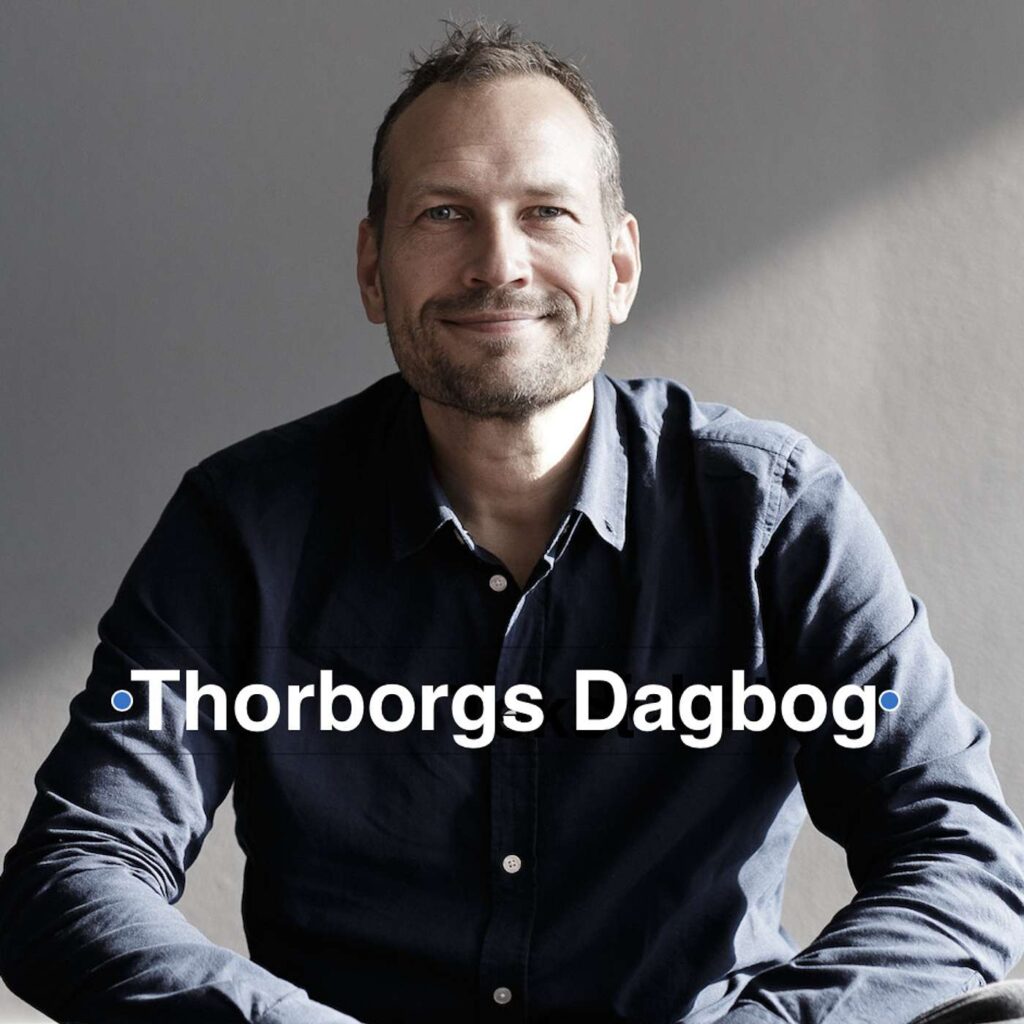
Today, I start with working from home and trust. But what I especially want to get to is AI and your business. If I were going to compete with Dinero today, how would I do it? And how can you use that question in your own business?
Thorborg’s Diary · No episode number · 13 September 2023
I’m sitting in my jacuzzi looking out over the garden. It’s simply one of the most beautiful places I know. So I might as well use the time to talk to you.
Do you have anything in the bank with your employees?
Lots of businesses are starting to call people back to the office. There may well be good reasons for that in some places. But I think you should start with the relationship between the business and its employees.
I sometimes use the expression that you need to have something in the bank with each other. If you’re flexible, helpful and decent as a boss, you put something into the account. Then your employee is also more likely to help when you’re facing a problem and need some extra effort.
It goes both ways. An employee who always delivers, helps others and gives something extra also has something in the bank with me. Then I’m more than willing to be flexible in return.
If one of our people works from home and pops out to Netto or the hairdresser, I don’t really care. What matters to me is what that person contributes. Not whether they sat in front of their computer for every single minute I’d imagined.
I think the 37-hour week is a pretty primitive measure for many kinds of work. It’s easy to measure, but that doesn’t make it a good measure of value.
Imagine two painters who both charge 400–500 kroner an hour. If one does the same job in half the time, that obviously makes a difference. You’re buying a result. The hours don’t tell the whole story.
In a factory, perhaps you can count how many things come out the other end. But how do you count a programmer’s contribution? Lines of code? That can also create some completely skewed incentives.
I mention a story about IBM and OS/2, where they reportedly measured lines of code. I haven’t checked the story myself. The point is that if you reward the quantity of code, you can get more code without necessarily getting a better solution.
If a programmer can create the same value in ten hours that another takes 37 hours to create, why should the first automatically be paid less?
I’d rather create a place people want to be
My approach is to give people good pay, decent computers, flexibility and an environment they want to work in. Good coffee, food, cake and good colleagues. And a boss who isn’t constantly breathing down their necks. I talk more about my approach to leadership in Min vej som leder.
Of course, there are jobs where you need to be in a certain place at a certain time. A train driver can’t just arrive five minutes late because he fancied doing something else. But that isn’t the same as developing software.
I also experienced a different culture when I lived in the US. If people feel they can be replaced very quickly, it affects their loyalty too. To me, flexibility, security and the willingness to go the extra mile are connected.
Our people have a lot of freedom to work from home. Yet many still come in. We’re human. We like being together, having a chat and giving each other a high five when something succeeds.
I drove my daughter to a management course in Valby for her first job at a sushi chain. Dinero is also over there near Carlsberg Byen. The drive from Skodsborg took around an hour. Previously, I’d thought 50 minutes was a lot. There really were a lot of cars.
On the other hand, it was a lovely drive with her. But it got me thinking about how many people are physically going to work again.
I think digital nomads will continue to exist. But I don’t think most people want to sit alone forever. The same goes for cinemas and concerts. You can have a big screen and good sound at home and still want to go out and experience something with other people.
During COVID, many people thought we’d never really travel again and everything would happen on Zoom from then on. I didn’t believe that. We have short memories, and we want to experience the world and be together.
I also find the airport busy. I fly quite a bit myself: to Bornholm, France and Norway in connection with Visma. It’s part of my life.
I believe more in solutions than in shaming each other
You could say I shouldn’t fly so much. I hear that too.
At the same time, I try to contribute to things that move us in a better direction. At that point, Amalo had installed around 1,200 heat pumps. I have a heat pump and solar panels at home and drive an electric car. And with Dinero, we’re helping move accounting away from paper.
I see it as a way of doing something good. You could also call it buying indulgences. I don’t have an audited carbon account proving that my activities offset my flights. But I feel I’m helping push solutions forward.
If you want to take the train to Rome, do it. I just don’t want us to spend all our energy shaming each other over our lives.
I believe more in technological development and international frameworks. Solar, wind, nuclear power and other solutions that can give us energy and prosperity with less impact.
More and more people in India and China are joining the middle class. They want a good life too. I don’t think those of us who’ve already had access to lots of opportunities can simply say no to that.
If your own ideal is to live with very little, that’s fine. I just don’t think that’s how we bring the rest of the world along. We need to find solutions people want to use.
You can be tired of AI. It doesn’t change the development
Now we come to what really interests me most. AI.
If you’re completely sick of hearing about it, of course you can switch off. But I think you’ll have a problem if you close your eyes to what’s happening.
I’ve followed Tesla’s work on self-driving cars for many years. There have been lots of promises that it was nearly finished. And then another year has passed.
I’ve talked enthusiastically about it myself too. But a car is somewhere it isn’t good enough for something to work almost every time. Rare mistakes can be serious. When I talk about percentages in that context, it’s to illustrate the difference between an impressive solution and one you can entrust with responsibility.
What interests me now is the story about Tesla’s new V12 approach. As I understand it, more of the driving logic is moving from handwritten rules to a system that learns from images and examples.
You could describe the old approach, somewhat crudely, as: If you see this, do that. If there’s a person by the road, react in this way. But the world is full of situations that are difficult to describe in advance. New roads, animals, people and traffic that look completely different from California.
In the new approach, driving footage is used to train the system to connect what the cameras see with how the car should brake, steer and accelerate. Among other things, by learning from good drivers.
In the recording, I repeat large figures about the old code and a short development time for the new solution. Those are details and stories I’ve heard, not something I’ve measured myself. And I know Musk can be very optimistic when discussing schedules.
But the change in thinking itself interests me enormously. Because if you can teach a computer to solve some of this, what could you teach it in a business?
I asked our technical director an uncomfortable question
I gave a pep talk to Lars, our technical director at Dinero. At that point, we have 22 engineers.
I think we have a strong product. I feel we’re far ahead in many areas. But that doesn’t mean we can sit back and be satisfied for the rest of our lives.
Danish tax rules and bookkeeping can be complex. But we’re not driving through traffic at high speed, having to react to everything happening around us.
So I asked: If I were starting a competitor to Dinero today, how would I do it?
Imagine having access to a large collection of accounting documents, bookkeeping entries and accountants’ corrections. Perhaps through an accountancy firm or by buying an old software company with years of experience and data.
I don’t know what you would actually be allowed to use from that kind of data. It’s a thought experiment about the method, not a description of how someone can simply take other people’s accounts.
Could you teach a system to see the connection between the accounting documents and the correct bookkeeping? And to learn from situations where an accountant has corrected something?
Lars objected that there are rules and mathematics. Two plus two must equal four. Of course he’s right. I’m not suggesting we should let a language model guess at a calculation.
But there are also choices and judgements around the work. That’s where I want to think about how much we can learn from examples instead of building everything the old way.
AI can also invent a spa that doesn’t exist
I’m not blind to the mistakes. I asked Bard about the best hotel in Gudhjem. It pointed to Hotel Klippen and described, among other things, a lovely spa.
It’s nice that it likes my hotel. But we don’t have a spa like that. We have showers. So it had made something up there.
We’re also working with an AI bot at Dinero that answers questions. My rough estimate in the recording is that it answers correctly around 80 per cent of the time. That’s my assessment at that point, not a published quality measurement.
There are still mistakes, and we monitor it. When we discover a wrong answer, we can contact the customer and correct it. It’s not something we just switch on and hope for the best.
I want to keep both the enthusiasm and the reality in view. There are huge opportunities, and there are things we need to handle properly.
You can read about Dinero’s current work to make bookkeeping easier on the page about Assistenten. That link describes the product today, while here I’m talking about our thinking in 2023.
AI and your business: How would I build Dinero from scratch?
This isn’t a plan for me to leave Dinero and start competing against us. It’s a way of forcing myself to think.
A product like ours represents many years of work. In the recording, I try out some rough calculations of person-years. Let’s use 160 as a hypothetical example. It’s not a count of the precise number of hours we’ve spent.
If you started today, you wouldn’t necessarily need the same effort. You could learn from what’s already out there. You could see which solutions customers understand and which problems still exist.
And you could build AI into both the product and the way you develop it.
My feeling is that perhaps you could get a long way with 20–25 per cent of the effort previously needed. That’s a feeling and a thought experiment, not a promise it can be done for that price.
But if a new business can build something good enough much more cheaply, that changes the competition. Then simply explaining how many years you’ve spent on your own solution won’t help.
That’s the question I think you should ask too: If you were starting your business today and competing against yourself, what would you do differently?
Could you use AI to solve something you currently need people, expensive processes or old software for? Could you do it faster? And would the customer even notice the difference you think matters so much?
My recording studio is a phone and a jacuzzi
Just take the podcast you’re listening to.
I record on an iPhone 12 Pro that’s around three years old, using the phone’s ordinary recording app. I’m sitting in a jacuzzi with pumps and a motor. There’s traffic from Strandvejen, birds and seagulls. The neighbour might be doing something, and my daughter might be making breakfast inside.
It’s hardly a recording studio.
I turn the recording into an MP3 and run it through Adobe Podcast’s audio enhancement. It removes a lot of background noise and makes the voice stand out more clearly.
You can look at Adobe Enhance Speechyourself if you want to explore the tool. Of course, features and prices may have changed since the recording.
I’ve talked to people who know about audio, and they’ve been surprised by the result. You can probably do it a little better in a proper studio. But the question is how much better it needs to be before listeners think the difference matters.
Would you pay extra for that difference? Would you reject a podcast because the sound wasn’t produced in a studio?
Feel free to write to me at martin@thorborg.dkif you have an opinion about it.
And now the bin lorry is actually coming past. I’ll just lift the phone while they empty the bins. There’s a bit of clunking and noise. This really is a fucking recording studio.
The Rolling Stones are making a new album. Mick Jagger is welcome in my jacuzzi if they need somewhere to record. We’ll work something out.
Of course, that’s a joke. I’m not saying an entire music studio is redundant. But for a podcast or an audiobook, perhaps you can get much further with much less equipment than before.
A good voice might become a different kind of business
I spoke with a woman who narrates audiobooks. She’s well known, but I won’t mention her name. She’s nearing the end of her career and was actually relieved she wasn’t starting out in that profession now.
Because what happens when a computer can read a book aloud with a really good voice?
It wasn’t Iben Hjejle I spoke to. I met her in connection with recording my own audiobook. I’m just using her name as an example of a human voice you might want to hear.
Would you pay an extra 20 kroner to hear a particular person instead of an artificial voice? Some people probably would. But are there enough?
Then I thought: Perhaps it isn’t just a threat at all. Perhaps a narrator could give permission for a model to use her voice and get paid for each book.
Instead of sitting and reading for many hours herself, perhaps she could earn money from more books being recorded in that voice. I play with amounts such as 2,000, 4,000 or 5,000 kroner. They’re hypothetical examples, not prices from an agreement.
If the model and the agreement were good enough, perhaps it could become a better business. It’s certainly worth considering before seeing it solely as something to fight against.
She also pointed to the theatre. I think the live experience of a person on stage is harder to replace. There, once again, we want to experience something together with other people.
I also try asking the question about Saxis and Capino
I’ve bought back into Saxis together with my partners, so we once again own a very large part of the business. And we’re working with Capino.
Saxis is a marketplace for buying and selling businesses. Capino connects people who need capital with potential investors.
My immediate thought is that marketplaces may be harder to replace with AI alone. You still need buyers, sellers and people who can find each other.
AI can help describe a business and make a lot of the work easier. But it doesn’t automatically create a marketplace with all its participants.
On the other hand, competition could come from elsewhere, such as large existing marketplaces. And perhaps I just lack imagination. I need to be open to that too.
I think about the risk in relation to the time we have to create value. If a business gets overtaken one day, it may still have been a good business in the years before.
As a very simple calculation: If you pay 100 for something and get 300 back over three years, it’s not necessarily a bad deal even if the future changes afterwards. That’s an example, not a promise of returns from Saxis or Capino.
My expectation at that point is that those businesses could have many good years ahead. Perhaps ten or fifteen. But I don’t know. I still need to think about what could change them.
ChatGPT improved the ad, and I had nothing to add
Rasmus, who’s CEO of Amalo, sent me an ad he was working on. We sell and install heat pumps, so it was something in that area.
He’d given the text to ChatGPT and asked it to improve it. It produced a new version and explained what it had changed.
I simply thought the new text was better. Sorry, Rasmus. But it was.
And I couldn’t really add anything. I wasn’t sitting there with some fantastic improvement the machine had missed.
It’s a small, concrete experience like that which makes the development real to me. We’re not just talking about something that might arrive in ten years. We can already use it to improve the work we do.
If you don’t challenge yourself, others will
I’m thinking of copywriters, lawyers, newspapers, recording studios, singers, musicians and artists. Those are very different professions, but all of them contain tasks that could change.
I’ve also seen AI images I find impressive. Some say they’re just copies. But people are inspired by other people too. I think we have to look at what actually comes out of it.
That doesn’t mean every profession will disappear. But you can’t assume customers will pay the same for something if someone else can deliver a good-enough solution at a much lower price.
Imagine a competitor who’s 80 per cent as good as you and charges 25 per cent of your price. That’s not a forecast with documented figures. It’s just a way to sharpen the question: How much of your extra quality is the customer actually willing to pay for?
I’d rather ask the uncomfortable question at Dinero while we’re doing well than wait for two entrepreneurs in a basement to show us the answer.
I think you should do the same. How would you outcompete yourself if you started from scratch today?
Have a fantastic day.
Editorial note: This post presents Martin’s thoughts from 13 September 2023. Figures about development work, prices, returns and future competitors are estimates or hypothetical examples. Tesla’s demonstration and technical changes are discussed based on his understanding at the time; Tesla describes FSD as a feature requiring active driver supervision. Product links show their current descriptions.
Listen to the episode
Watch the episode on video
Listen in your podcast app:
All episodes on Apple Podcasts · All episodes on Spotify · All episodes on Amazon Music · RSS Feed