

Are we in an AI bubble?
Are we in an AI bubble? I compare it with the dotcom bubble. I talk about Jubii, Dinero’s support agent Fin and why concrete results can take time to show in the accounts.
Thorborg’s Diary · Episode 113 · 26 November 2025
Listen to the episode
Watch the episode on video
Listen in your podcast app:
Apple Podcasts – this episode · The podcast on Spotify · All episodes on Amazon Music · RSS Feed
Find more episodes here
Hello and welcome to Thorborg’s Diary. It’s 26 November, and I’m on my way to work. I was actually listening to Pilestræde with Anne-Sophia Allarp and Ulrik Bie discussing whether we’re in an AI bubble. I haven’t even finished it, but I was so inspired I paused it and started recording myself.
Incidentally, how this works is quite amazing. I’m sitting in my Audi speaking through the car’s microphone to my iPhone. Afterwards AI can clean up the sound so much it almost sounds as if I was in a studio. That’s just one small place the technology already makes a difference.
An AI bubble and memories of the dotcom days
But back to the bubble. I was there when the dotcom bubble inflated and burst around 2000 and 2001. I had Jubii, and it was a strange time. There were fantastic opportunities, but also lots of hot air.
Among other things, I remember visitors from a big investment bank in London. As far as I remember it was Morgan Stanley. Real finance people with pinstripes, waistcoats and the whole outfit. They came to look at us in an old accountancy building on Falkoner Allé. It wasn’t exactly impressive. I remember old windows with larvae between them. It wasn’t a glittering tech palace.
But the office wasn’t what interested them. They asked how many people used us, how often they returned and how fast we were growing. All those internet metrics. Users, visits and activity.
Then we came to finances. We were getting close to making it add up. We weren’t simply burning loads of money. I thought that was good. A growing business starting to get revenue and expenses under control.
It wasn’t in their world. When they discovered we were around break-even, interest disappeared. It was almost seen as a sign we weren’t ambitious enough. If we really believed in the big future, we should spend a hell of a lot of money becoming even bigger.
That was the mood. How big is your burn rate? How much can you spend? How much could you grow with another sack of money? Making money wasn’t what earned most respect.
At one point Børsen also had a front page with roughly 20 of the new internet rising stars. Jubii was included, but criticised for being among the least ambitious. Roughly the same logic: We needed grander gestures and more spending.
As I remember, a year later around two of those companies remained. That was interesting. Apparently we weren’t as stupid as we’d seemed when everyone was completely high on growth.
That doesn’t mean the others didn’t have promising ideas. The problem was taking an enormous future opportunity and treating it as an already functioning business. Much of it didn’t have proper business models underneath.
Everyone could see the internet would be big. But where did the money come from? Who would pay? How many would advertise? What could you charge? That was much less clear.
And when the mood turned, it happened fast. I can’t remember exactly what triggered it. I have an image of something involving Microsoft and a five-to-seven-per-cent fall, but I may well remember incorrectly. What matters is that suddenly there was a completely different assessment of internet companies’ value.
It became very concrete for us. Many ad buyers were internet companies themselves. When they went bankrupt, we lost both future revenue and money for ads already delivered. A customer could owe for a campaign and simply disappear. It wasn’t fun.
We sold big banner campaigns that could cost 200,000 or 500,000 kroner. It looked lovely when sales came in. But it was vulnerable too if much of the market consisted of companies living on the same optimism and investor money.
Pluslinks gave Jubii a down-to-earth business
One thing that helped us was a much more down-to-earth business. We had our Pluslinks. A company could buy a highlighted position in our directory when people searched for something relevant. It cost around 1,500 kroner plus VAT.
It wasn’t a big, sexy campaign. But a small business could understand it. If you worked in a particular field, you could get a more visible position when someone looked for what you sold. There was a concrete product and a price you could assess.
We brought in people used to telephone sales, including from Børsen. Then they called businesses and sold these placements. It was much more tangible than sitting hoping the next big internet company would buy a huge banner campaign.
That story is interesting because the internet didn’t turn out to be a bad idea. Quite the opposite. It became far bigger than most had imagined. What we overestimated was how quickly all the opportunities would turn into money.
In the short term, our expectations can be completely over the top. In the long term, we can at the same time underestimate how great the change will be. Both can be true at once. You can read more about my years with Jubii in If You’re Gonna Be Dumb, You Gotta Be Tough.
Look at Amazon, eBay and all the other companies that actually built something. The internet changed how we shop, communicate and run businesses. It wasn’t an illusion. But that didn’t mean every company with a dotcom name had a good business.
So I understand people comparing AI to that period. There’s enormous excitement. Unbelievable sums are being invested. And companies are valued on expectations to be fulfilled far into the future.
AI already creates value in Dinero’s support
But there’s also a difference I think gets overlooked: We can already see very concrete value in AI. It isn’t only something we imagine we might benefit from one day. We use it now, and it changes the economics of our businesses.
I can take an example from Dinero. Two days before recording, we had around 1,400 support chats ahead of the VAT deadline. About 1,100 were handled automatically by Fin, our AI agent. People handled around 300. That’s almost four in five enquiries handled by a bot.
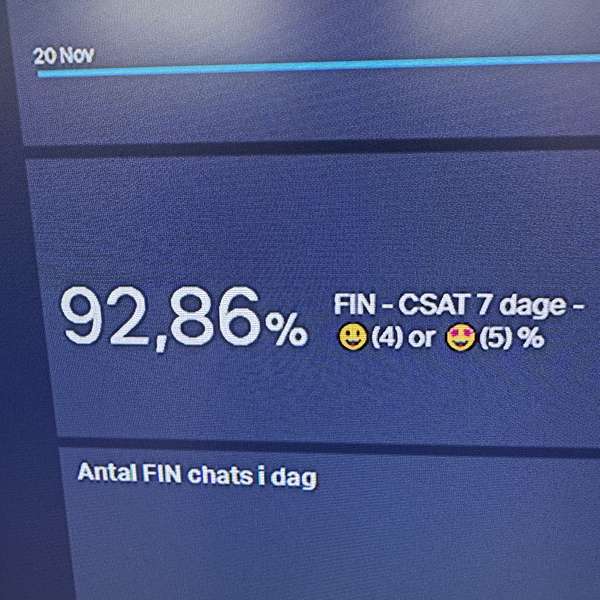
And customers are satisfied. Customer satisfaction with human support is around 88, while AI support is around 92. That’s bloody good.
Of course you shouldn’t read that as the bot being smarter than all our employees. It handles many easier questions. More complicated things are passed to a person. So it’s not a comparison of exactly the same tasks.
But that doesn’t change that a very large share of customers get a good answer quickly. Fin is always there. It can reply immediately and doesn’t get tired because lots of questions arrive at once. We didn’t have that service in the same way before.
That matters for us too. If we get more customers, we don’t automatically need proportionally more people answering all the same questions. It’s not just a PowerPoint about a future saving. It’s happening in daily operations.
Nor can 1,100 chats simply be translated into a particular number of paid hours. Some questions are quick, others take longer and people work on several things at once. But the effect is very real. We can serve more customers with the resources we have.
And this is only the beginning. Today it’s largely about answering. At the time of recording, Fin could actually already issue credits to customers. For example, a customer whose annual subscription renewed automatically although they wanted to switch to monthly or let it expire. Next we’re training Fin for even more actions so an employee doesn’t need to go through every step each time.
Those ordinary practical tasks hold lots of value. Not because they sound fantastic at a conference, but because they’re repeated thousands of times.
So when people ask whether AI can create money at all, I get a little impatient. Yes, it can. It already does. That doesn’t mean every company selling AI makes a bottom-line profit. But customers pay for the technology because they benefit from it.
Nvidia sells chips. Technology is bought from major suppliers. Google and others develop solutions businesses use. There’s real activity underneath this and real revenue. That’s different from only counting clicks and hoping someone later works out what they’re worth.
The benefits take time to reap
At the same time, there’s a delay you need to understand. We started working on this two or three years ago. Only now are we really starting to reap the benefits. And I think we’ll see a clearer effect in our 2026 accounts and an even bigger one in 2027.
My guess during recording was that most other businesses would only show clearly better accounts in 2027 at the very earliest, and probably not until 2028. That wait was what I feared could cause disappointment and falling share prices. If another business only begins now, it may take time to get the same effect. You need to build, learn and train. You need to work out how the technology fits your business. And do it properly.
It’s a bit like a farmer. You can’t stand in the field the day after sowing and conclude farming doesn’t work because there’s no finished harvest. Work needs doing, and there’s a period when money goes out before the benefit comes in.
At Dinero we also have around 15,000 users getting access to new AI features. We want to help them with more automatic bookkeeping and running a better business. If we can make their everyday life easier and help them improve their business, more will want to stay with us.
That may also mean some businesses do better and live longer. And they can grow without immediately needing to leave us. It’s not only a support saving. It’s a change in how much we can do for our customers.
Prices can fall even if the technology works
But could the stock market have a major fit along the way? Of course. People can be disappointed that benefits don’t appear as quickly as imagined. Accounts may not match the highest expectations. Then prices can fall.
That’s simply not the same as the technology not working. A company can be too expensive on the stock market even if what it does has a big future. We saw that with the internet too.
I can’t tell you when the market will get scared, how much something will fall or which companies will win. That’s not what I’m doing here either. I’m describing what I see in a company where we actually use AI every day.
And what I see makes me very optimistic in the long term. We’re heading into changes far bigger than the small things we’ve already made work.
I don’t intend to jump in and out of my investments every time someone gets nervous. That’s my own approach. I think long term and believe the technology will create much more value than we’ve seen yet.
So yes, expectations can be excessive. Yes, some things may be overpriced. And yes, a fall may come. But I think it’s a mistake to use that as an argument that the whole thing is hot air.
Well, now I need to go back and hear the rest of that podcast. I’ve been reacting before even finishing. Ulrik and Anne-Sophia may have said something really wise in the part I haven’t heard. Then I’ll see whether I also tease them about it next time we meet.
Thanks for listening.