

Being a good speaker is a super-skill
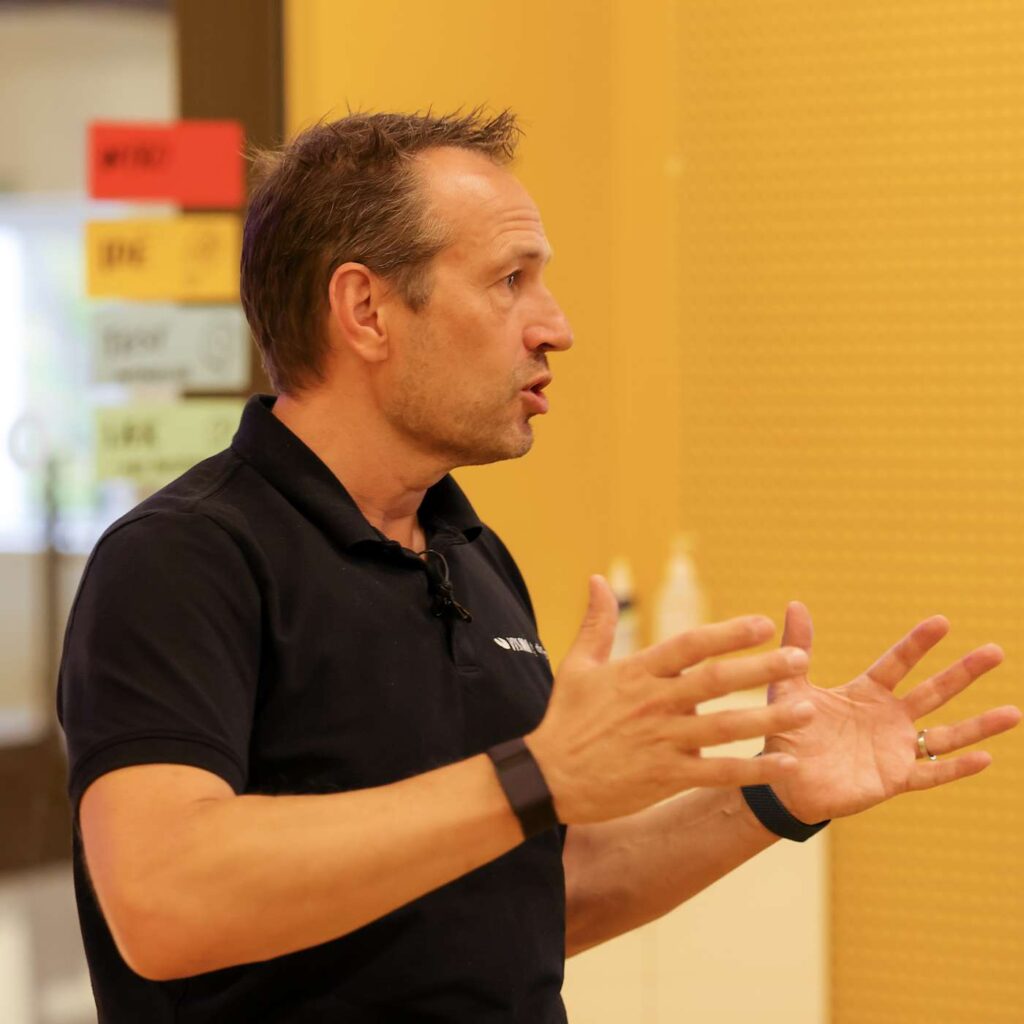
Speaking in front of others can take courage. At a stag party I watched people take electric shocks and do all kinds of physical challenges that pushed their limits. But when we had to stand up and tell a positive story for one minute, only four people did it.
I found that enormously thought-provoking. The fear of speaking in front of others can be so great that people would rather have a cockroach in their mouth.
And that’s a shame, because being a good speaker is an incredibly useful skill. It’s also something you can learn.
On my way to a walk with new employees
I’m sitting in my lovely car on my way to my lovely job at Dinero. The sun is shining, and all in all things are actually going pretty well.
I’ll soon be 54 and can soon call myself an angry old white man. I suppose we’re the last legitimate prey on the Danish plains, people you can laugh at and belittle without anyone raising an eyebrow.
But we have broad shoulders, as Helle Thorning once said. So we have to carry quite a bit too. There’s plenty to deal with, but we shouldn’t whine.
Today I’m going for a walk with new employees. I do that regularly, depending on how many people have joined.
Usually there are just a few of us. We walk from Carlsberg Byen through Søndermarken and Frederiksberg Have and take a look at the elephants if they’re outside. It’s very pleasant.
The walk takes about three hours. Along the way I find somewhere we can sit. Some days sheltered from the rain, other days in the shade. There I tell the story of Dinero and the culture we want to have.
Why I wanted to create Dinero
I started with the idea that there was no accounting program for the very smallest businesses.
Back then, many people used e-conomic. It’s an excellent accounting program, but as I saw the market, it was built for more professional users who already knew how things should be recorded.
If you couldn’t work it out yourself, you could end up recording something completely wrong. Or you’d use a bookkeeper and send off your receipts in a cardboard box every three months.
A few weeks later, you’d be told what you needed to pay in VAT and tax. That was a bit unfortunate if you’d expected a VAT refund and instead had to pay 20,000 kroner.
Going to the bank the day before the payment deadline and saying you’re a bit short of cash isn’t the best starting point for a constructive conversation.
I thought it ought to be possible to build accounting rules into software. Rules are exactly the sort of thing computers are good at.
Some accountants and bookkeepers thought their judgements were far too difficult for a computer to make. I challenged them on that and asked for specific examples. I rarely thought they came up with anything a computer couldn’t help with or do faster.
David, Anders and a simple invoice
A friend pointed me towards David and Anders. David was a graphic designer and Anders was a programmer. They’d built websites for organisations and businesses and had grown tired of the accounting programs they had to use themselves.
So they’d built their own. They had a few hundred paying customers but had got a bit stuck. It was obvious that they knew how to build a product like that.
We joined forces. My partner in Amino, Nicolai Frisch, was involved too, and we went full throttle.
First we made a free invoicing program to see whether people wanted it. Many thousands came to love it.
The clever part was that you saw the actual invoice in front of you while you wrote it. What you saw was what you got. That made it logical where the different pieces of information belonged, instead of sitting with an odd list of fields.
Then came a simpler accounting program, also free. Later came the Pro version. Initially, the price was around 97–100 kroner a month, and we began offering help with VAT accounting among other things.
It’s no longer the same product
At the time of recording in spring 2024, the price is around 300 kroner. Some users are angry that it’s gone up.
I can understand that if you only look at the number. But I think you also need to look at how the product has developed.
It’s a bit like sitting in an Audi RS e-tron GT and saying: Why does this cost more than the wooden box on wheels I bought for a third of the price? Both can drive, after all.
In Dinero you can photograph a receipt, get it into the program and have the information read from it. The program suggests what you’ve bought, asks what you used it for and helps record it.
You can automate recurring payments from the bank. We can help you assess a customer’s creditworthiness before you send goods and risk not getting paid.
We have an app that, at this point, I’m proud to say is one of the best rated in the Visma group. And support is open from eight in the morning until eleven at night, 365 days a year.
I actually think a little bit has happened.
Yet some people give us a poor rating because they think we simply raise the price without doing anything.
There are around 95 of us. I mention, among other things, a support organisation of 28, a product department of eight and a marketing department of around ten.
Marketing also needs to make sure more people discover the product. If we don’t sell it, development becomes more expensive for the users who remain.
The walk is also about culture
That’s the story I’ll be telling the new employees. Normally it takes 35–40 minutes. You’ve had the condensed version here.
I also explain how we help each other and have each other’s backs. We shouldn’t gossip about or bully one another. New people need to understand the spirit we want in the company.
It shouldn’t just be something we say. We need to live by that culture. I want departments to work together instead of walking around annoyed with each other.
The walk is a way of bringing the company together and passing on its story and culture. That’s also why I’m telling you about it here: Perhaps you can use some of it in your own everyday life.
A stag party outside my comfort zone
I went to a stag party at the weekend. I have to admit I’m not the biggest fan of the traditional version with paintball, a stripper and all that stuff where the point is to humiliate the person getting married.
I’ve had two stag parties myself because I’ve been married twice. The last one was really nice. The first was fun too, but it was bloody expensive. You’ll have to get that story another time.
So I was a little hesitant about spending the whole day with around 15 men. I only knew a couple of them reasonably well and didn’t even know the groom particularly well.
Yes, I know a lot of people. But being in close company with a whole group I barely know is still a little outside my comfort zone.
I thought: It’s probably good for you, Martin. Try something new.
It was a varied group with good stories
Peter, who was getting married, was from Amager, and several of his old friends were there.
One was a lorry driver, lived on Funen, had five children and got up around half past one every morning to drive. A really lovely guy with a life very different from mine.
Another was a refuse collector. When he finished work, he worked at his own little car repair shop, and in the evenings he was building a house with his wife.
I thought: Bloody hell, man. He was around forty and thought he could handle it, but he also explained how stressed he really was.
There was also a man who’d co-owned large construction companies. He had a very expensive car and had been through some dramatic things that had changed him. He was kind and interesting to talk to, and we had quite a bit in common.
So it was a very diverse group, and that led to some really good conversations.
It was fine to say no
A soldier from the Jaeger Corps took us through a series of challenges that pushed our limits. There were electric shocks, cold water, exercises that made your legs shake and other things I’m normally not particularly keen on.
But it was actually well run, and he was a really nice guy. It was also perfectly okay to say: I don’t want to do that one.
I politely declined having a large cockroach in my mouth. I was more up for a tarantula or a snake.
I also skipped taking a hard punch to the stomach. I’ve got something down by my groin that occasionally pops out, and I didn’t want to end the day in hospital.
There was also an electric fence you could hold on to. Some took it calmly. Others practically jumped into the air. I bloody well skipped that too.
I’m almost 54. I don’t need to do something because of peer pressure just to be able to say afterwards that I dared. If other people get something out of it, that’s fine. But my little office hands don’t need that experience.
The price of my podcast is a bit of everyday chatter
Now I’ve taken a long time to get to the point. That’s the price of my podcast: You also get drawn into things from my life that may not be especially relevant to you.
Think of it as an ad break. Other podcasts tell you which meal box to buy. With me, you get a bit of everyday chatter.
I might talk about Saxis and Capino because I want to get those businesses moving. It’s also about something close to my heart: Getting Danish business going more.
And when I talk about Dinero, it’s mainly to share my everyday life and how I try to do things. We have around 93,000 users at this point and around 5,000 weekly podcast listeners. A couple of extra users from the podcast aren’t what everything depends on.
One positive story in one minute
The most interesting thing about the stag party was one of the final exercises.
We had to step forward one by one and tell a positive story that had made an impression on us. That was all. About a minute.
The Jaeger Corps soldier had told us about the exercise early in the day, so we had plenty of time to think about it. Nobody was caught off guard.
We’d been together all day, laughed, said ouch and shown different sides of ourselves. We’d really bonded.
Yet only four people stood up. I think more people tried the electric fence than this exercise.
And those final points could even help the group win the competition.
One of them simply said he’d had a lovely day with Peter and the others, and that taking part had been a great experience. He finished by congratulating Peter.
It could be that simple. You didn’t have to dig up a major personal story.
Fear of speaking can loom larger than physical fear
I was really surprised by how many people recoiled at having to step forward.
The other exercises were designed to trigger fear: The water, the pain, the snake, the spider or an arrow that had to break against your throat.
But telling a little positive story in front of a group you’d spent the whole day with seemed even harder for many.
I know the fear of speaking in front of others can be enormous. It was just striking to see that comparison so clearly.
I was scared the first time I stood up too. I’ve given several hundred talks over many years, but I probably had to do about a hundred before I thought I was reasonably good.
It’s a discipline and a craft that takes practice. You don’t have to be a professional to say a few words at a birthday or a wedding, but you can improve each time.
Being the CEO of a major company doesn’t automatically make you a good speaker
There aren’t very many businesspeople who become really good public speakers.
A business club once asked whether I’d come and speak. I think my fee was around 22,000 kroner. They told me they could get a director from Carlsberg for 15,000, and he was much more successful than me, after all.
That was absolutely right. I haven’t been CEO of anything remotely like Carlsberg.
But I asked: Are you looking for the CEO of a large company, or are you looking for a speaker?
They’re two different things. You can be good at running a large company without being an engaging and interesting communicator.
I’m not saying no major company directors can give good talks. But one ability doesn’t automatically come with the other.
Don’t spend the opening proving your worth
Many people use far too much PowerPoint. They show customer logos, graphs and revenue figures to justify their presence on stage.
We have so many billions in revenue, and Danfoss and Grundfos are our customers. Blah, blah, blah.
If you spend the first 15–20 minutes propping yourself up, I think you risk losing the audience completely.
If you’re invited to speak as a director of Carlsberg, people know it’s a big company. They also know you can probably do something special. You don’t need to spend fifteen minutes proving it.
You should spend the time on what they’ve come to hear.
My own style doesn’t follow the textbook
I took a presentation skills course myself. My good friend Anders Gisselmann has also helped me put talks together.
He once said that almost everything I did went against what’s normally taught.
I speak quickly and loudly. I don’t move around much. I don’t use PowerPoint and don’t always wait for people’s applause.
But in some strange way it worked for me. So he also said I shouldn’t change it.
On the other hand, I shouldn’t teach others to copy my approach. It might not work for them.
So I’m not going to give you a formula for how to stand, move or overcome your nerves either. I’ve heard the advice about imagining the audience naked, but I’ve never tried it myself and don’t know whether it helps.
My recommendation is to practise and get help with presentation skills, communication and body language. A course can give you tools to handle the fear and find your own way of speaking.
A talk should make people want to do something
If, as a leader, you can stand in front of your employees in a relaxed and convincing way, you have a huge advantage. That also applies to voluntary work and many other situations.
You often need to pass on energy, enthusiasm, information or a new perspective.
To me, a talk or a pep talk is different from in-depth teaching. I’m not supposed to teach the audience everything about a topic. I’m supposed to make them want to do something, think differently or improve their skills.
When I give a talk about entrepreneurship, the aim isn’t to teach people the entire craft in an hour. I want to give them the courage and belief that they can become entrepreneurs or get better at it.
And then I give them a few practical things they can go home and try. If they take away one or two ideas and have the energy to do more, it’s been a success.
I’m not giving that many talks right now because there are lots of other things I want to do, and talks take quite a bit of energy. But that’s still how I see their purpose.
My story can give another leader courage
The same applies to talks about leadership. I started out badly myself, made loads of mistakes and gradually became relatively good.
If the audience thinks that fool on stage could learn it, perhaps they can too. That’s one of the most important things I can pass on.
I don’t offer a single recipe for good leadership. People lead differently. I offer basic ideas and some practical things they can develop in their own leadership.
You don’t have to stand in front of a hundred people
The skill is useful whether you’re giving a confirmation speech, welcoming guests or speaking to the whole company.
It can also be used with just one person.
My daughter has become a manager at Lagkagehuset. Imagine she spots something in the shop that isn’t working. It’s a hypothetical example, but perhaps she wants to change the layout or organisation and needs management’s backing.
Then she needs to give a coherent, reasoned explanation of why money needs to be spent or something changed. That’s a form of presentation too, even if there are only one or three managers sitting in front of her.
It’s about asking: Who is the audience? What do they already know? What do they need to understand, and what do I want to happen?
Communication is about other people understanding you
You need to adapt to the people you’re talking to. If you use unfamiliar terms and academic language in front of people who don’t work with it, that doesn’t help your message.
On the contrary, it can make you look like a fucking clown trying to show off.
To me, communication is about getting the message across to others. It’s not about showing how clever you are.
Difficult language can also signal insecurity or that you haven’t understood your material yourself. Making sentences long and words complicated isn’t a sign of knowledge in itself.
You need to make it understandable to the person who needs to use it.
Speaking in front of others: Take the chance and practise
I keep coming back to that exercise. People would rather take an electric shock than tell a little positive story.
My advice is to take the chance and stand up. You get better every time. Being able to speak reasonably well brings so many advantages throughout your life.
You can come across as more open, determined and decisive, and be better able to share your ideas.
If, against all expectations, you like what I keep saying, subscribe to the podcast on the service you use. Then you’ll be notified when there’s something new. And if you don’t like it, at least you know what to stay away from.
Have a fantastic day.
Listen to the episode
Watch the episode on video
Listen in your podcast app:
All episodes on Apple Podcasts · All episodes on Spotify · All episodes on Amazon Music · RSS Feed