

Is my book a bestseller - No!
Is my book a bestseller? No. I haven’t sold 100 copies yet, including pre-orders and the audiobook. I’m disappointed, but I’m not surprised. And although sales are modest, the project has given me much more than a number on a sales chart.
Thorborg’s Diary · Episode 146 · 2 November 2026
Listen to the episode
Apple Podcasts · Spotify · RSS
Why would people read 360 pages about me?
That’s actually a very good question. Many people follow me to learn about business, get inspiration or be entertained. That doesn’t necessarily mean they want to read an entire book about my life.
I never expected my autobiography to become a huge bestseller. But I suppose I still expected to sell a little more than I have so far.
My own explanation is, first and foremost, that I’m just not that interesting. The audience who want to go that deeply into my story is fairly small.
I also think being open about AI has cost me sales. People hear that I’ve used AI and assume the book was generated by a machine. If I thought that about a book, I wouldn’t be particularly keen to read it either.
25 hours of recordings are just the beginning
I’ve recorded more than 25 hours of myself talking about my life. Of course I used technology to transcribe it. In my opinion, manually typing out all those hours would be an enormous waste of time.
But a transcript is not a finished book. There are mistakes, pauses, ums and ahs. And spoken language works very differently from written language.
ChatGPT helped make the material more usable. Then I went through it, word by word, rewriting it. Some passages could stay because they were my own words. Elsewhere, the meaning had been misunderstood, the text had become too polished, or something had been distorted. That needed fixing.
By my own estimate, that part of the work alone took 100–150 hours. Then I used Claude as a critical publishing editor and rewrote the material again. Back and forth over many rounds, before proofreading and the finished book.
AI also helped me find old articles, dates and things I’ve talked about before. I had around 700 of my own YouTube videos transcribed and used the material to remind me of stories I’d forgotten.
I wanted to talk to my mum while I still could
My mum is 89. If I want to hear from someone who knew me when I was very little, she’s the person I need to ask. One day she won’t be here anymore, and that opportunity will be gone.
That was a major reason for writing the book now. I wanted to hear her story and include her memories of my childhood.
Besides, it’s been a bloody fascinating project. I’ve learned a lot about AI and about myself, and refreshed my memory of a lot of things from my life.
The book can also stay on sale on my website for many years. If I sell five a week for the next ten years, that adds up. I don’t need to sell them all in the first week.
Behind the scenes on Debatten
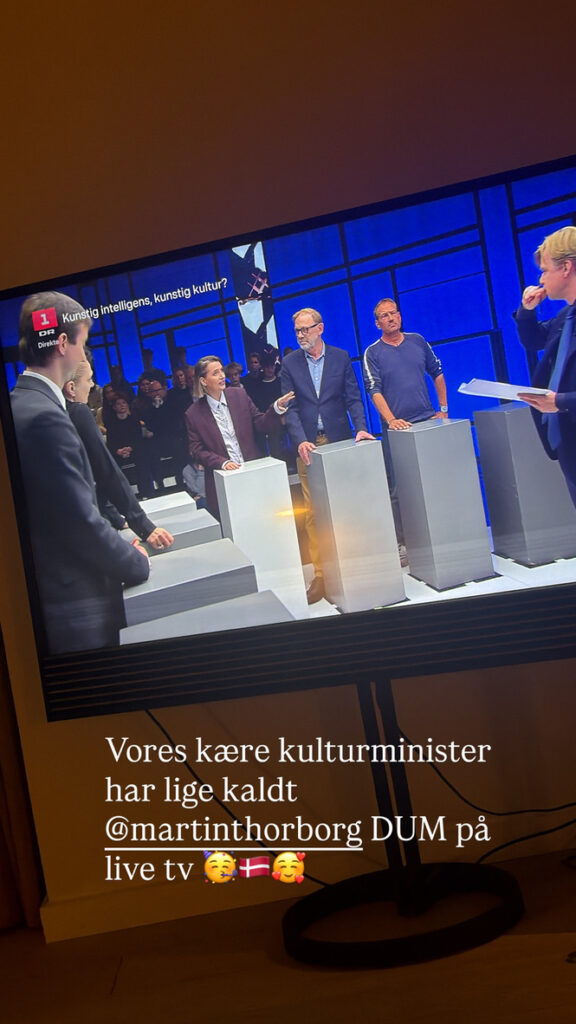
I went on DR’s Debatten to discuss AI and culture. It’s a subject I find incredibly exciting, because I’m both enthusiastic about the possibilities and deeply worried about the consequences.
You arrive well ahead of time. There’s make-up, instructions on where to stand and move, and a run-through of the format. Before the broadcast, the participants sit and chat. I found the atmosphere really friendly and constructive.
But once we got into the studio, the tone changed. I felt Zenia Stampe’s reactions towards Michael Dyrby were condescending, and I let myself get provoked. By the time it was my turn to speak, I was angry.
I take responsibility for that. I should have stayed cooler and stuck to what I’d actually come to talk about. Instead, I ended up saying something I shouldn’t have said too.
It’s a tough format. You’re on live TV with your heart racing, and you don’t know exactly when you’ll get to speak or what you’ll be asked. That explains some of the pressure, but it doesn’t take away my responsibility for my own reaction.
Enthusiastic and worried at the same time
I have a lot of sympathy for artists and others who find their work being used to train AI without a fair agreement. I personally think the way this has happened is deeply problematic.
In the episode, I use our glossary at Dinero as a small example. We’ve put a lot of money and work into explaining business terms and calculations. It used to bring us a lot of visits and visibility. I feel that AI has eroded that value, and I suspect the material has also been used for training. I can’t prove that last part.
But even if you’re angry about how the technology came into being, I don’t think you can make it go away. So we also need to discuss how we live and work with it.
Where should young people start?
The question I really wanted to discuss concerns young people. Many start their working lives doing routine tasks. They learn from colleagues, gain experience and find out how a workplace works.
What happens when AI takes over those tasks? At Dinero, I can already see that we need fewer young people in some roles. In my estimation, AI now handles more than 80 per cent of the help provided by our support team.
I don’t have the answer to how we then train the next generation. I just don’t think you can respond by saying that companies should hire people for tasks that technology does better and faster, without also addressing the competition.
It’s a real dilemma. How do we give young people experience while making sure businesses can compete? That’s the debate I’m missing.
Electricity and data centres
I also start the episode by venting a fair amount of frustration about energy policy. I think opposition to nuclear power has been short-sighted, and I’m tired of hearing the argument about how long it takes to build when we could have started many years ago.
I also struggle to see the victory in keeping data centres out of Denmark if we continue using AI and simply let the investment and electricity consumption happen somewhere else. Those are my views on that discussion, and you’ll hear them in today’s diary too.
Is my book a bestseller? Disappointed with sales, happy with the project.
This podcast is a personal project too. As I talk, I get ideas and clarify my own thoughts. You can be a fly on the wall if you like.
It’s the same with the book. I’ve had conversations with my mum, learned a lot and helped get a debate going. It’s been a bloody fun process.
Is the book a bestseller? No. Am I disappointed with sales? Yes. But overall, I’m still glad I wrote it.